Showing posts with label Dinner. Show all posts

Monday, October 7, 2013

Easy-Pleasy Rice

This is a regular feature of the Cuban weekday menu, perfect when you're pressed for time.  It is easy to make and a very satisfying dish.  It's also a good way to sneak some vegetables into a meal for picky eaters.


Arroz Con Salchichas


Description: A tasty, colorful, and super-easy meal to prepare on busy days.


NOTES (Before you get started): 

* The traditional recipe calls for Vienna sausages (the kind you get in the little cans) but we prefer the taste of hot dogs.  

** FOR THE MIXED VEGETABLES I put my own together using frozen peas, carrots, corn, and pearl onions.  These are all pretty essential to the dish, but if you don't have pearl onions on hand, simply chop some onions and sauté those in the pan until they are translucent and soft, prior to adding the rice.  You can also chop some red pepper and sauté that along with the onion, if you'd like.

Use a pan for which you have a lid, as you will need to keep the lid on while the rice cooks down.  If you don't have such a pan increase the liquid slightly, to adjust for evaporation, and cover the pan with a sheet of aluminium foil while it cooks down.


Directions:

1. Coat the bottom of the pan with 2 tablespoons of olive oil over medium heat. 

2. Put the rice into the hot pan and stir the rice around to coat evenly with the olive oil.  Allow the rice to cook in the oil until it turns slightly more a solid white than a translucent white.  About two minutes.

3. Toss in the sausages and stir them around with the rice for a minute, then add the two cups of liquid.  If the temperature is right, this should sizzle a bit.  If it does not, allow the water to bubble before adding the seasonings.  

4. Add turmeric and stir to distribute it evenly.  

5. Add salt and pepper as needed. 

6. Add mixed vegetables and cover with the pan lid, lower the heat down to a simmer and allow it to rest untouched for twenty minutes or until all the liquid has been absorbed by the rice.


Easy Metric Conversions:

6 Hotdogs = approx. 180 grams 
4 tsp Olive Oil = 60 milliliters
1 cup long-grain rice =  185 grams
1 tsp turmeric = 2.3 grams
3 cups mixed vegetables = approx. 500 grams

Budget Factor
It's always good to know what a plate costs you to make.  Restaurants keep this in mind, why shouldn't we?  



These are only estimates for reference.  Your local ingredient costs may vary.  Currency converted at DKK5.00 to the Dollar and DKK7.50 to the Euro.


Another Great Recipe from: www.paprikaandtime.blogspot.dk

Did you make it?  Did you enjoy it? Did you improve on it?  I'm eager to hear whether you found this dish as tasty as we did.  Please comment below with any remarks, critiques, or alternative suggestions you have to make this recipe even better!

Wednesday, October 2, 2013

¡Olé! Encore..Spanish Savory Rustic Mash

This recipe is featured as an Encore dish for left over Rustic Mashed Potatos, but it can easily be prepared from scratch.  It is guaranteed to transport your taste buds to Toledo.

Patatas Revolconas with Scalded Eggs
Paprika & Time 2013
Description: This is a great Encore Dish for any extra you have left over from your Rustic Mashed Potatos with Caramelised Onions. Or you can easily make it from scratch.

Directions: 

1.  If you're going to make this as an Encore Dish and use Rustic Mashed Potatos as your base, then all you have to do to start with is chop the onions into fine pieces, and bring them to a boil them in enough water to cover, along with three of the garlic cloves and the two bay leaves.  Add a pinch of salt to the water.  Lower the temperature to medium heat and cook covered until the onions are tender and clear, the garlic is softened but not mushy, and the water is infused with the aroma of the onions, garlic, and bay leaves.  Once the onions and garlic are ready, remove them from the heat and set aside.  Keep them covered.

OR..If you are making this from scratch, cut each potato into four large chunks. (You can peel them first or brush them thoroughly with a vegetable brush and leave the skins on.) Put the potatos in the water with the onions, three garlic cloves and two bay leaves.  Add a pinch of salt and sufficient water to cover all of them, and boil as above, until the potatos are tender.  When they are done, remove the bay leaves, drain the liquid reserving one cup, and mash the potatos with the garlic using a potato masher.  Set aside.

2.  While the onions and potatos and garlic above are cooking, in a large frying pan, place enough olive oil to cover the bottom of the pan and sauté the remaining three cloves of garlic at medium heat.  You want them fried golden but do not allow them to brown as they will become bitter.  Once they are ready, place them in a small bowl or a small dish and set aside.

3.  In the same pan, without removing the oil, fry the strips of bacon which you have cut into slivers.  Allow them to become crispy, but not dry.  Once they are ready, set aside.  Remove any excess oil from the pan and set aside.  

4.  Take the pan off of the direct heat and place the potato mash in the pan, add 1 tsp of the paprika, 1 tsp of the smoked paprika, and ¼ tsp of the cayenne.   Blend so that the paprika mixture is evenly distributed throughout the mash.  If you are using the left over mash from a previous menu, then add the onions and garlic at the same time, and put in enough of the reserved water to warm up the potatos more quickly and make the mash moist.  Add half the crisped bacon and blend into the potato mixture.  Return the pan to the heat source and at medium heat, turn the mixture so that it continues to blend and heat up.  Once the mixture is heated through, lower the temperature of the pan to just keep warm without burning.  Sprinkle with the chopped parsley, if you have it.

5.  Add the remaining paprika to the oil you have remaining and blend thoroughly with a fork.  Set aside.  (You will probably have to blend it again before pouring as the paprika has a tendency to sink and settle.)

To scald the eggs:

6.  Boil water in a medium sized pot, enough to fill it three quarters of the way.  Pour in a good stream of vinegar, about one quarter cup, and a pinch of salt.  Bring the water just to a boil (don't let it bubble too much) and crack the eggs into the water, two at a time.  Using a slotted spoon, gather the whites around the yolk gently in a rolling motion.  Once the whites are cooked and while the yolk is still liquid inside, gently lift the eggs from the pot with a slotted spoon and place aside on a plate with a little bit of hot water on it so that the eggs won't stick to the plate.  Once you have cooked all the eggs, serve the potatos and place two eggs on top of each plate.  Alternatively, you can serve the potatos mixture onto warm plates and place the eggs directly on top of the potatos as they come out of the pot.

7.  Sprinkle the fried garlic and the remaining bacon on top of the plates and drizzle with the paprika/olive oil mixture.  I have put a lot of garlic into this recipe because we find it tasty.  If you do not, you can certainly reduce the amount of fried garlic you prepare.  Give it a chance, though.  If you fried it to just the right point, it will be a lovely salty-sweet and will add a lot to the dish.  Patatas Revolconas just aren't the same without some fried garlic.

Paprika & Time 2013


If space is limited in your kitchen, you can place the potatos in a large serving dish and place all the eggs, crisped bacon, and fried garlic on top.  Drizzle with the oil, and serve at the table so each person can serve themselves.  

Most Spanish cooking takes quick response time at the stove, and constant attention.  I recommend pre-measuring and preparing all ingredients in advance of starting the cooking process, to avoid troublesome delays.

Easy Metric Conversions:
1/3 Pounds of bacon = 150 grams of bacon
2 tsp Paprika = 4.6 grams
1/2 tsp Cayenne = 1.3 grams


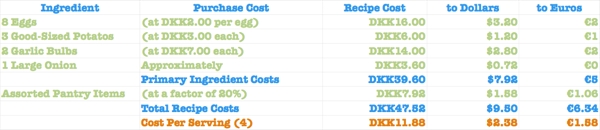
Budget Factor
It's always good to know what a plate costs you to make.  Restaurants keep this in mind, why shouldn't we?  

NewImage


This cost is for the recipe made from scratch.  As an Encore, the cost for the recipe is lower.

These are only estimates for reference.  Your local ingredient costs may vary.  Currency converted at DKK5.00 to the Dollar and DKK7.50 to the Euro.


Another Great Recipe from: www.paprikaandtime.blogspot.dk

Did you make it?  Did you enjoy it? Did you improve on it?  I'm eager to hear whether you found this dish as tasty as we did.  Please comment below with any remarks, critiques, or alternative suggestions you have to make this recipe even better!

A Steak Dish That Is Sure To Please

Southern Style Chicken Fried Steak

Description: This is one of my favorite comfort foods. It's a relativelly easy meal to prepare and the flavor is out of this world 

 
Directions: 
Marinade the Steak for at least 40 minutes and no more than an hour prior to proceeding with the recipe.  For best results, seal steaks in a plastic freezer bag with the marinade, turn the bag to ensure all the steaks are well covered and place in fridge.  Turning the steaks over every twenty minutes helps to ensure they marinade evenly.

For the breading:

You want to crush the crackers by hand, not put them in a food processor.  This doesn't take a lot of effort and it gives you a nice mix of fine and larger bits which gives the breading a much nicer texture and crunch.  The easiest way to prepare the breading is to place the crackers inside a freezer bag, crush the crackers inside, put the dry breadcrumbs over that, followed by the flour, baking powder and seasoning.  Close the bag, crush it all together, so that you break up whatever over-large chunks remain of the crackers, then shake it all thoroughly so that it is blended.  


1. Pound the steaks vigorously with the spiked side of a mallet meat tenderiser until the steaks are about 1/4 inch thin.  Turn over as you are pounding to be sure you tenderize both sides evenly.  

2. Beat the eggs with a fork until they are thoroughly blended and they froth.  Place these in a plate that is slightly deep so that the eggs don't splash around as you coat the steak.  Pour half the Breading mixture onto another plate and distribute it evenly for coating.  Dip the flattened steaks into the egg mixture turning them to coat evenly, then place the steak on the breading mixture.  The best way to ensure an even coating is to sprinkle the top with a little bit of the reserved breading so that you can gently press down on the steak to thoroughly coat the part underneath then turn the steak over and repeat, pressing down again until all the breading is firmly incorporated into the egg.  The coating should be dry to the touch, not sticky.  If it sticks when you touch it, you need to sprinkle more of the reserved breading on top and distribute it again, pressing down gently again.  Place the breaded steak on a third plate you have set aside.  Repeat with the remaining steaks.  NOTE: You want to layer the steaks on the plate when they are breaded but you don't want them to stick after sitting, so I recommend sprinkling some breadcrumbs between the layers.  You'll find you have plenty of breading to do this, and some will remain on the breading plate when you're finished which you can sprinkle over the steaks before you refrigerate them to protect them.  I don't cover the steaks before I put them in the fridge.  I suppose you could, but I find it helps to dry and set them a little more if they are uncovered.  Chill the breaded steaks for at least ten minutes before frying.  

3. Pour oil into a frying pan large enough to hold 2 steaks at a time, and deep enough to hold the oil with enough space remaining at the top so that it doesn't spill over when the meat goes in.  A 12 inch pan should be just about right.  Turn the stove to maximum heat, and allow the oil to rise to a temperature of approximately 360 degrees Fahrenheit.  When the oil is hot, remove the steaks from the refrigerator and place in the frying pan, two at a time.  I find it is good to listen to the oil in order to know when to turn the meat.  When the steaks first go in, they should sink, froth slightly and have a low-pitched frying sound.  As they reached their done point for one side, they begin to float and the pitch of the frying sound rises slightly.  It should take 1 ½ to - 2 minutes per side.  You'll want them to be a rich golden brown.  Turn the steaks in the frying pan with tongs and then remove them to a plate which has a layer of paper towels to absorb any excess oils which remain.  You may want to keep the steaks in a warm oven (225 degrees Fahrenheit), especially if the weather is cool.  If so, be sure to place them on an oven-proof dish when they come out of the pan.

To make the gravy:

4. Whisk together milk and dry ingredients until a nice froth forms.

5. Melt butter in a 10 inch pan until it is clear and starting to bubble, but not browned.  Pour in the milk and flour seasoned mixture and whisk to blend thoroughly, cooking at a medium-high heat so that it bubbles nicely, until it thickens.  This needs constant watching as the milk in the gravy may cause the whole thing to froth over and burn.  Stay with the gravy until it is done and ready to pour.  Because the gravy can form a thin film on top, it is probably best to leave this step for very last in all your meal preparation.  In other words, have your side dishes ready with the steaks before you go to make the gravy.  You want the gravy to have a nice body and flow smoothly.  It thickens a little more as it cools.  If you reduce it too much, it might get too thick as it sits on the table.

[Purists will tell you that you should prepare this gravy by draining bulk of the frying oil, reserving about two tablespoons of drippings, and prepare the gravy in the same pan as the drippings and the cooked bits which fell to the bottom of the pan.  I like the gravy made separately with butter better, but you're welcome to try it the old fashioned way too.]  

Pour a little gravy on the steaks when you serve them, and serve the rest in a gravy dish for your diners to lavish on as they please.    

I served this with a side of Rustic Mashed Potatos with Caramelized Onions, and some simple peas and carrots.  I can't see serving Southern food without Biscuits or Corn Bread, so I chose Lazy-Day Whole Wheat Biscuits.


Easy Metric Conversions

(4) 5 ounce steaks = (4) 140 gram steaks
2 cups crackers = 100 grams
1/2 cup = 118 ml
1/4 cup = 60 ml
1 tablespoon = 15 ml
1 teaspoon = 5 ml
1/2 teaspoon = 2.5 ml
4 cups = 1 liter
1/4 inch = 2/3 centimeters
12 inch pan = 30 cm pan
10 inch pan = 26 cm pan
360 degrees Fahrenheit (for the oil) = 180 degrees Celsius
225 degrees Fahrenheit (to keep the steaks warm as you prepare gravy) = 107 degrees Celsius
4 1/2 tablespoons of butter = 63.75 grams of butter

Budget Factor 

It's always good to know what a plate costs you to make.  Restaurants keep this in mind, why shouldn't we?  

Recipe Cost


These are only estimates for reference.  Your local ingredient costs may vary.  Currency converted at DKK5.00 to the Dollar and DKK7.50 to the Euro.

Another Great Recipe from: www.paprikaandtime.blogspot.dk
 
Did you make it?  Did you enjoy it? Did you improve on it?  I'm eager to hear whether you found this dish as tasty as we did.  Please comment below with any remarks, critiques, or alternative suggestions you have to make this recipe even better!

Easy and Tasty Whole-Wheat Biscuits


Lazy-Day Whole Wheat Biscuits


Picture by Paprika & Time 2013
Description: Lovely crumbly whole wheat drop biscuits, perfect to accompany any meal or to eat alone with butter and jam.

Directions: 
1.  Preheat oven to 450 degrees Fahrenheit, or 230 degrees Celcius (Gas Mark 8)

2.  Combine all the dry ingredients in a large bowl.  Blend all together with a whisk in order to distribute them evenly.  

3.  Place cut butter or vegetable shortening pieces in the flour and toss around to cover.  Using your hands, break up the butter or shortening in the flour, continuously keeping the pieces covered in flour until you form coarse crumbs.  Alternatively, you could use a pastry cutter to blend or cut two knives at opposite angles across the butter or shortening, to break them up inside the flour.

4.  Add buttermilk and stir until mixture is evenly moistened and has formed a soft and sticky dough.  Using the heel of your hand turn the dough and knead it in the bowl about five times, until all the ingredients are blended and the dough takes on more body.  It will still be somewhat sticky.

5.  Grease a baking sheet and lightly dust it with about a tablespoon of cornmeal.  

6.  To make small biscuits, drop them by the spoonful onto the baking sheet.  To make large biscuits double the quantity of dough for each.  To make jumbo biscuits, divide the dough into four equal quantities and drop all four onto the baking sheet. 

7.  Sprinkle tops of biscuits with poppy seeds.

8.  Place biscuits in pre-heated oven and allow them to bake for 10-12 minutes or until they are a rich golden brown.  

9.  Melt the butter while the biscuits are baking, and when they are out of the oven, drizzle the butter evenly over the warm biscuits.

Serve and enjoy!  

Picture by Paprika & Time 2013


If you have any left over, you can store them in an air-tight bag to enjoy for breakfast the following day with butter and jam.  Just warm them up in a toaster oven for about five minutes; you may want to cover them loosely with aluminium foil so the tops don't burn.


Easy Metric Conversions

1 cup All Purpose Flour = 125 grams
1 cup Whole Wheat Flour = 120 grams
½ cup Cornmeal = 80 grams
2 tablespoons sugar = 25 grams
1 ½ tsp baking soda = 7 grams
½ tsp baking powder = 2.5 grams
¼ tsp salt = 1.5 grams
4 tablespoons butter = 56.75 grams
1 cup buttermilk = 237 ml
½ cup melted butter = 120 ml
2 teaspoon poppy seeds = 5.75 grams

Budget Factor
NewImage


These are only estimates for reference.  Your local ingredient costs may vary.  Currency converted at DKK5.00 to the Dollar and DKK7.50 to the Euro.


Another Great Recipe from: www.paprikaandtime.blogspot.dk

Did you make it?  Did you enjoy it? Did you improve on it?  I'm eager to hear whether you found this dish as tasty as we did.  Please comment below with any remarks, critiques, or alternative suggestions you have to make this recipe even better!